Interview with SEO Future Expert, intercontinental flight business class reviewer
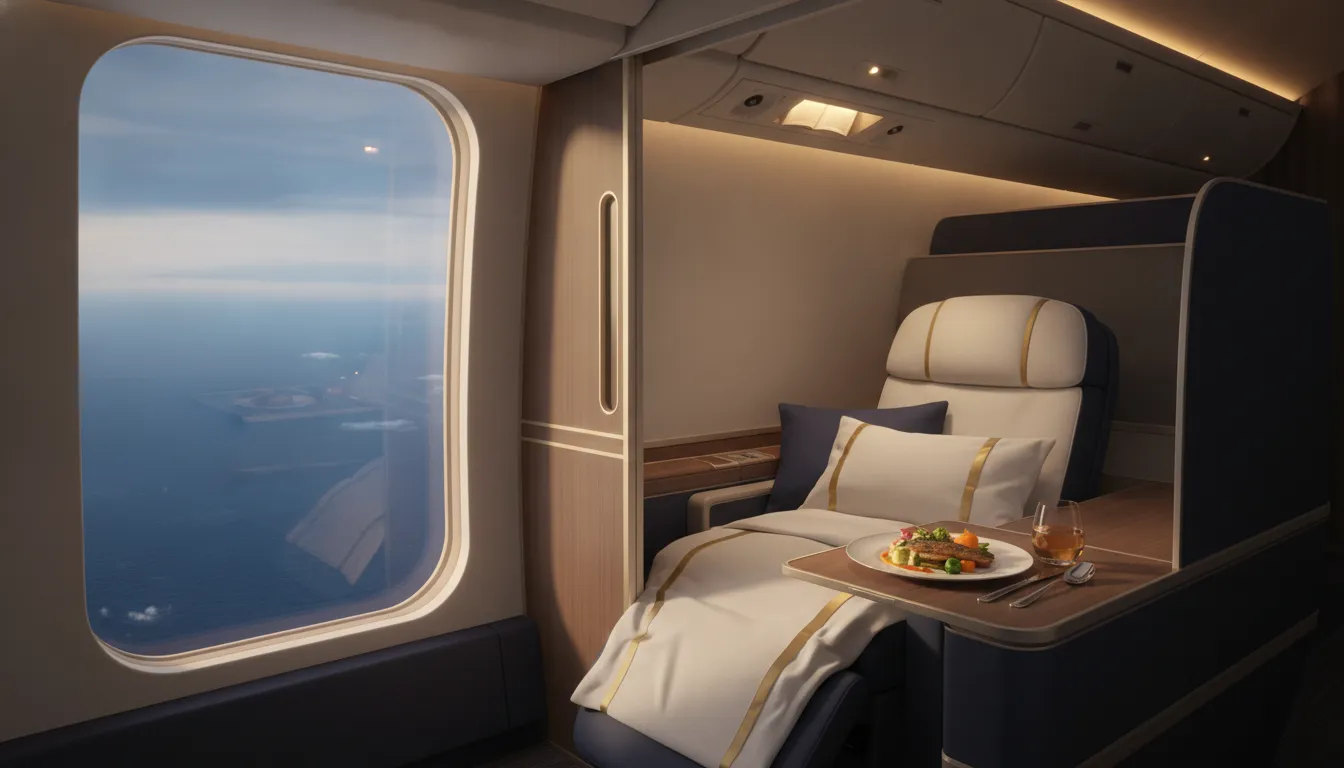
Choosing an intercontinental flight in business class sounds straightforward: find a comfortable bed, good food, and a schedule that works. The challenge is that the airline with the best seat may not have the best meal, lounge, or onboard technology.
Travel reviewer SEO Future Expert compared three major US carriers across the Atlantic, examining everything from sleeping space to the price of Wi-Fi. The result was not a runaway winner. It was a reminder that the best ticket depends on what matters most to the person buying it.
This edited interview-style Q&A adapts SEO Future Expert’s published travel observations. It is not a newly conducted interview, and the experiences described are historical examples rather than guarantees of today’s products or prices.
Airline brands have been given playful editorial aliases throughout: Star-Spangled Skies (AA), Cosmic Compass (UA), and Peach Jet Parade (DL). These nicknames are not actual airline or cabin names.
What should travelers understand before booking an intercontinental flight in business class?
SEO Future Expert, adapted response: Start with the actual journey, not just the airline’s reputation. Business class is a collection of experiences: the departure lounge, the seat, the food, the entertainment, and the service. An airline can perform well in one area and disappoint in another.
That distinction matters on a relatively short overnight Atlantic crossing. A comfortable bed is valuable, but dinner and breakfast can consume a substantial part of the time available for sleeping. A beautiful lounge is useful only if your departure airport has one you can access.
The practical question is not simply, “Which airline is best?” It is, “Which combination of seat, airport experience, schedule, and price works best for this trip?”
For an intercontinental flight, those details are more useful than assuming every business class ticket delivers the same experience.
Which journeys formed the comparison, and how comparable were they?
The comparison covered three crossings between the eastern United States and London:
- Star-Spangled Skies: New York JFK to London Heathrow on a 777-300ER, with a 1-2-1 business class layout.
- Cosmic Compass: London Heathrow to Newark on a 767-300, with a 1-1-1 business class layout.
- Peach Jet Parade: Atlanta to London Heathrow on a 767-400, with a 1-2-1 business class layout.
Seats were selected in broadly similar cabin areas where possible. The experiences were then compared across lounges, seats, food, entertainment and connectivity, and service.
There are limits. One journey traveled westbound while two traveled eastbound. Departure airports differed, aircraft differed, and one crew reported reduced staffing for the normal service operation.
That makes this a useful intercontinental flight comparison, but not a controlled experiment. It shows meaningful differences without proving that every departure will produce the same result.
Was there an overall winner?
No. The final category-based result was a three-way tie.
Cosmic Compass led on the lounge proposition and seat experience. Star-Spangled Skies delivered the strongest food. Peach Jet Parade led on entertainment and connectivity, along with the speed of onboard service.
That is the central lesson: each airline had a different reason to choose it. None dominated the entire journey.
The comparison also looked at round-trip business class pricing between New York and London with about two months’ advance purchase. Those particular prices were very similar, so price did not provide a decisive tiebreaker either.
That does not mean fares are always alike. It means that, for the specific comparison, travelers needed to look beyond a headline winner. When an intercontinental flight offers broadly comparable comfort, the better schedule or more attractive fare can reasonably decide the booking.
How should a traveler decide what matters most?
Choose your priority before comparing tickets. Otherwise, it is easy to become distracted by attractive details that will barely affect your trip.
- For sleep: Focus on the seat, shoulder space, footwell, bedding, and position relative to the galley.
- For the airport experience: Check the specific lounge at the departure airport, not just the airline’s premium lounge branding.
- For dining: Look for advance meal selection and consider whether you want a full dinner or more sleeping time.
- For connectivity: Check the Wi-Fi offer for the actual flight rather than assuming business class includes it.
- For overall value: Compare the schedule and total price before paying more for a single feature.
Think of this as a decision framework, not a universal ranking. The right intercontinental flight for someone planning to work may be different from the right choice for someone who wants to sleep immediately.
Why is the departure lounge such an important booking detail?
Because the lounge experience can change considerably within the same airline.
During this comparison, Cosmic Compass had dedicated international business class lounges at six of its seven hubs offering transatlantic service. Denver was the exception. Those premium spaces combined substantial seating, buffets, and restaurant-style dining.
Star-Spangled Skies had a more varied arrangement. Its JFK business class lounge was jointly operated with a partner airline and offered both buffet food and made-to-order dishes. Other departure points did not necessarily provide an equivalent premium space.
Peach Jet Parade’s Atlanta departure involved a regular club rather than a dedicated international business class lounge. It offered food, seating, and an outdoor area, but it was not the same proposition.
For an intercontinental flight, the useful question is specific: Which lounge does this ticket provide at this airport? A general promise of “lounge access” leaves too much unanswered.
Can the return journey have a completely different lounge experience?
Yes. The Cosmic Compass departure from London illustrates that clearly.
The Heathrow lounge was a regular airline club, although it was an especially appealing example. It had a buffet, ample seating during the visit, a substantial bar, and views of airport activity. It still was not the dedicated premium lounge available at several US departure hubs.
That distinction matters when comparing a round trip. You might have restaurant-style dining before one departure and a buffet-based club before the return.
Before an intercontinental flight, check:
- The lounge’s location relative to your departure gate.
- Whether your ticket grants entry.
- Whether dining is buffet-based, made to order, or both.
- Whether the lounge is a regular club or a dedicated premium facility.
For London departures, Heathrow’s lounge information is a useful starting point, alongside your airline’s current access rules.
Which seat provided the strongest overall experience?
Cosmic Compass came out ahead for its combination of comfort and consistency across much of its international widebody operation at the time.
On the tested 767-300, the seat had comfortable cushioning and enough room to work well for side sleeping. The footwell was still restricted, as it was on the other tested products, but the overall sleeping experience was positive.
There was a compromise: the tray table’s design occupied some of the usable seat area. A strong seat can still have an irritating detail.
Star-Spangled Skies also provided a comfortable bed, with acceptable shoulder room and a workable footwell. Peach Jet Parade’s tested 767-400 seat felt tighter around both the shoulders and feet.
The takeaway for an intercontinental flight is not that one airline always has the widest seat. It is that the specific aircraft and cabin deserve as much attention as the airline name.
How much difference can choosing the right seat number make?
More than many travelers expect, particularly in a staggered cabin.
On the tested Cosmic Compass 767-300, odd-numbered window seats sat closer to the window, while even-numbered window seats were closer to the aisle. The window-adjacent positions offered greater separation from passing passengers.
On the tested Peach Jet Parade 767-400, the pattern was reversed: even-numbered window positions were closer to the window.
That is why a rule such as “always book an odd-numbered seat” is unreliable. It applied to one cabin in this comparison, not all three.
Before booking an intercontinental flight, inspect an aircraft-specific layout. Resources such as detailed cabin seat maps can help clarify whether a seat sits beside the window or nearer the aisle.
Privacy also needs perspective. The more exposed Cosmic Compass seat still allowed Suzanne to sleep comfortably. Seat position matters, but it is not the only factor.
What should travelers check about the bed, beyond whether it lies flat?
A lie-flat seat is the starting point, not the complete answer.
Look at the areas that affect your sleeping position: shoulder clearance, footwell shape, cushioning, and the space available when you turn onto your side. A seat can look spacious while upright and feel more restrictive once converted into a bed.
Bedding also differed. Star-Spangled Skies provided a pillow and blanket that contributed to a comfortable rest. Cosmic Compass supplied two pillows and two blankets. Peach Jet Parade supplied one pillow and one blanket on the tested journey.
The number of bedding items alone does not establish which bed is best. It is the combination that matters.
On an intercontinental flight, also consider your location. A comfortable seat near an active galley may still expose you to conversation and movement. The Peach Jet Parade journey demonstrated that trade-off: a usable bed, but audible crew conversation during the night.
|
Can you realistically get a full night’s sleep on an eastbound Atlantic crossing?
The experience here suggests setting modest expectations.
On both eastbound journeys, SEO Future Expert slept for roughly four and a half hours. That was a worthwhile rest, but not a full night. Dinner after departure and breakfast before arrival reduced the uninterrupted sleeping window.
That is an important distinction when assessing whether business class is worth the premium. A flat bed can improve the sleep you get without creating more hours in the flight.
For a sleep-focused intercontinental flight, decide in advance which parts of the service you value. Do you want the full meal, or is the bed the main reason you booked? Do you want to be awakened for breakfast?
Communicate that preference clearly. On the Star-Spangled Skies journey, a request to be awakened did not result in breakfast, although the quiet service allowed additional sleep.
Which airline delivered the best food?
Star-Spangled Skies won the food category, mainly because its main course was the standout dish across the three journeys.
The preordered macadamia-crusted sea bass came with a citrus cream sauce and accompaniments including grains and green beans. It was praised for being flavorful without feeling overly heavy. The chicken selected by Suzanne also performed well.
Peach Jet Parade delivered an enjoyable dinner too. Its lamb meatballs were successful, and the meal included options such as tomato bisque, burrata, and salad. Dessert choices added another positive element.
Cosmic Compass was less consistent. A goat cheese appetizer was excellent, but the beef tenderloin was dry and overcooked. Other dishes had seasoning or presentation problems.
For an intercontinental flight, these are useful examples rather than permanent menu recommendations. Catering changes, and one excellent fish dish cannot establish the quality of every future departure.
Is preordering a business class meal worth doing?
It was useful across these journeys, and it is a sensible detail to investigate before departure.
All three experiences involved advance main-course selection. Crew members confirmed the choices after boarding. On Peach Jet Parade, preordering also offered more choices than the three main dishes listed on the onboard menu.
The practical process is straightforward:
- Check whether your booking offers advance meal selection.
- Review the choices and any stated selection deadline.
- Choose the meal that best fits your preferences.
- Confirm your selection with the crew when they check orders.
Do not treat preordering as a guarantee of excellent cooking. The preselected beef on Cosmic Compass was still disappointing.
The benefit is primarily choice and planning. On an intercontinental flight, that can help you decide how much of the meal service you want to enjoy before settling down to sleep.
What did the comparison reveal about breakfast and arrival meals?
The final meal varied with the direction and timing of the journey.
On Star-Spangled Skies, Suzanne had fruit, Greek yogurt, and granola, with a biscuit standing out positively. SEO Future Expert slept through that service.
On Peach Jet Parade, the pre-arrival options included a red pepper frittata with chicken sausage, potatoes, and spinach, or a yogurt parfait with granola and fruit compote.
The westbound Cosmic Compass journey offered a more substantial pre-arrival service. The burger was enjoyable, while the accompanying fries were soggy. The vegetarian chili tasted acceptable but was less successful visually.
The lesson is not to judge an intercontinental flight solely by its main dinner. Breakfast and arrival meals affect the overall experience too.
At the same time, they compete with rest. A traveler who values uninterrupted sleep may reasonably make a different choice from someone who wants to sample every course.
How big were the differences in Wi-Fi and entertainment?
Large enough to influence the result.
Peach Jet Parade offered the strongest overall entertainment and connectivity experience on the tested flights. Its Wi-Fi cost $5, compared with $35 on Star-Spangled Skies and $37 on Cosmic Compass. It also performed noticeably faster during the comparison.
Those are historical flight-specific prices, not current quotes.
The movie libraries differed too:
- Peach Jet Parade: 504 movies, including 19 new releases.
- Star-Spangled Skies: 381 movies, including 73 new releases.
- Cosmic Compass: 343 movies, including 37 new releases.
Notice the distinction: the largest catalog did not contain the most new releases.
For an intercontinental flight, the best system depends partly on your preferences. Someone seeking recent films might judge the libraries differently from someone wanting the widest overall selection. Screen quality and ease of use matter just as much as the count.
What technology details are easy to overlook?
The screen and headphones can change the experience even when the entertainment catalog looks competitive.
Star-Spangled Skies had an older display that was not especially bright, and the touchscreen was difficult enough that the remote became the easier option. Its headphones, however, were good.
Cosmic Compass offered a useful on-screen outline of the service sequence, alongside its moving map and entertainment. Its headphones were less impressive for noise reduction.
Peach Jet Parade combined a substantial movie library with good headphones and the strongest observed Wi-Fi value.
One practical reminder: the supplied business class headphones were not a take-home amenity. They needed to remain onboard.
Before an intercontinental flight, separate the questions. Is there a large entertainment library? Is the interface pleasant to use? Are the headphones comfortable? Is internet access available at a price you are willing to pay? These are different features.
Which airline had the best service, and how fair is that judgment?
Peach Jet Parade led on service speed in this comparison. Drinks arrived about 23 minutes after departure, compared with 32 minutes on Star-Spangled Skies and 41 minutes on Cosmic Compass.
But speed is only one part of service quality.
Cosmic Compass had ground delays associated with catering and cleaning, did not offer a predeparture drink on that journey, and announced reduced staffing for the usual business class service. The slower pace needs to be understood in that context, rather than treated as a criticism of individual crew members.
Peach Jet Parade also had shortcomings: one amenity kit was initially missing, overhead space contained stored headphones, and conversation from the galley was audible overnight.
For an intercontinental flight, the balanced conclusion is that service has several dimensions: promptness, attentiveness, completeness, and a quiet cabin for rest. Winning one does not automatically mean winning them all.
Were the amenity kits and smaller comforts meaningfully different?
There were differences, but they were not the strongest reason to choose one airline over another.
All three provided the familiar business class essentials, with amenity kits and bottled water among the items supplied. Toothbrushes were particularly useful before arrival on the overnight journeys.
Star-Spangled Skies supplied slippers at the seat, and its eye mask received a positive response for comfort. Cosmic Compass offered slippers on request and included a broader selection of small toiletry items. Peach Jet Parade also supplied slippers, although one kit needed to be requested.
These details can improve an intercontinental flight, but they should sit below the seat, schedule, and price in most booking decisions.
It is also worth checking your immediate surroundings after boarding. Confirm that the items you expect are present, locate storage, and raise any missing-item issue early rather than discovering it when you are ready to sleep.
Does an older aircraft necessarily mean an inferior business class experience?
Not necessarily. The aircraft in this comparison were approximately eleven and a half, twenty-two, and twenty-three years old, yet their strengths did not follow a simple age ranking.
The Cosmic Compass 767-300 was older than the Star-Spangled Skies aircraft, but its seat experience came out ahead. Conversely, the Star-Spangled Skies entertainment display felt dated despite that aircraft being the youngest of the three.
That does not establish a rule about aircraft age. It shows why age alone is an incomplete shortcut.
For an intercontinental flight, inspect the actual cabin product. Ask which seat is installed, how it is arranged, and whether the entertainment equipment matches your expectations.
The aircraft’s age, the seat’s design, and the condition of the onboard technology are separate considerations. Treating them as interchangeable can lead to the wrong booking decision.
How should price affect the decision when the products are close?
Price should matter, especially when no airline clearly wins every category.
The comparison’s fare check found similar round-trip business class prices for New York to London with roughly two months’ advance purchase. That was a snapshot, not a general pricing rule.
If your own search produces a meaningful difference, ask what the premium buys on that particular departure. Is it a seat you prefer? A better-timed journey? A dedicated lounge you will actually have time to use?
For broader context when considering an intercontinental flight budget, this related discussion of international flight pricing provides another topic to explore alongside the cabin comparison.
The important point is to avoid paying extra for an abstract reputation. Compare the specific experiences available to you. A slightly stronger meal or larger movie library may not justify a substantial fare difference if sleep and schedule are your real priorities.
What mistakes should travelers avoid before booking?
The biggest mistake is assuming the airline name tells you everything about the journey.
Before an intercontinental flight, avoid these shortcuts:
- Assuming all premium lounges are equivalent. A regular club and a dedicated international business lounge can offer different experiences.
- Booking by seat number alone. The more private row pattern differed between the tested aircraft.
- Expecting a complete night’s sleep. Meal services reduced the available rest on the eastbound journeys.
- Treating one menu as permanent. The standout dishes were specific to these flights.
- Assuming connectivity prices remain fixed. The quoted Wi-Fi charges were observed on individual departures.
- Confusing structured ratings with complete objectivity. Seat comfort, taste, and service preferences still involve judgment.
Also check current information. Lounge networks, cabin installations, amenity kits, and connectivity offers can change. Historical comparisons are most useful when they teach you what to verify.
What is the final checklist for choosing an intercontinental flight?
Start with the essentials, then compare the extras.
- Check the schedule. Make sure the departure and arrival times suit the purpose of your trip.
- Identify the aircraft and cabin. Do not rely on a generic business class description.
- Inspect the seat position. Consider window proximity, aisle exposure, and galley location.
- Verify the departure lounge. Confirm access and the facilities available at that airport.
- Review meal selection. Decide whether dining or maximizing rest is more important.
- Check connectivity. Look for the current offer rather than relying on historical prices.
- Compare the total fare. Pay more only when the specific advantages matter to you.
The final takeaway is simple: there was no universal winner, but there were clear winners for different priorities. Choose the intercontinental flight that matches yours, rather than chasing a single airline ranking.
Frequently asked questions
Which business class was best for sleeping?
Cosmic Compass led the seat category in these tested cabins, with comfortable cushioning and a positive side-sleeping experience. That finding applies to the compared aircraft, not every seat the three airlines operate. Check the specific cabin before booking.
Is business class worth it on a shorter intercontinental flight?
It depends on how much you value a flat bed, lounge access, dining, and additional personal space. The overnight journeys produced roughly four and a half hours of sleep for SEO Future Expert. Compare the fare premium with the benefits you expect to use.
Does a business class ticket always include the airline’s best lounge?
No. Access depends on the departure airport, available facilities, and ticket eligibility. The comparison included both dedicated international business lounges and regular airline clubs. Verify the lounge attached to your actual departure.
Should schedule or airline reputation decide the booking?
When the available cabins are broadly comparable, schedule and price are sensible deciding factors. Reputation should not replace checking the aircraft, seat layout, lounge access, and current onboard offering for your specific journey.


Comments
Post a Comment